NVIDIA’s official blog published an article detailing the comprehensive liquid cooling technology used in the Rubin platform.
NVIDIA stated that all cloud service providers and data center operators building systems for the Rubin platform are driving the transition to liquid cooling.
The bottleneck of AI computing expansion is shifting from chip supply to power supply and thermal management supply.
NVIDIA’s thermal design engineering team has developed a new cooling loop architecture, bringing two major changes. First, Rubin servers feature a clean, sealed front panel, whereas traditional air-cooled servers require a perforated front bezel. Second, fully liquid-cooled servers achieve higher rack density than air-cooled counterparts, reducing the footprint from six rack units to just two.
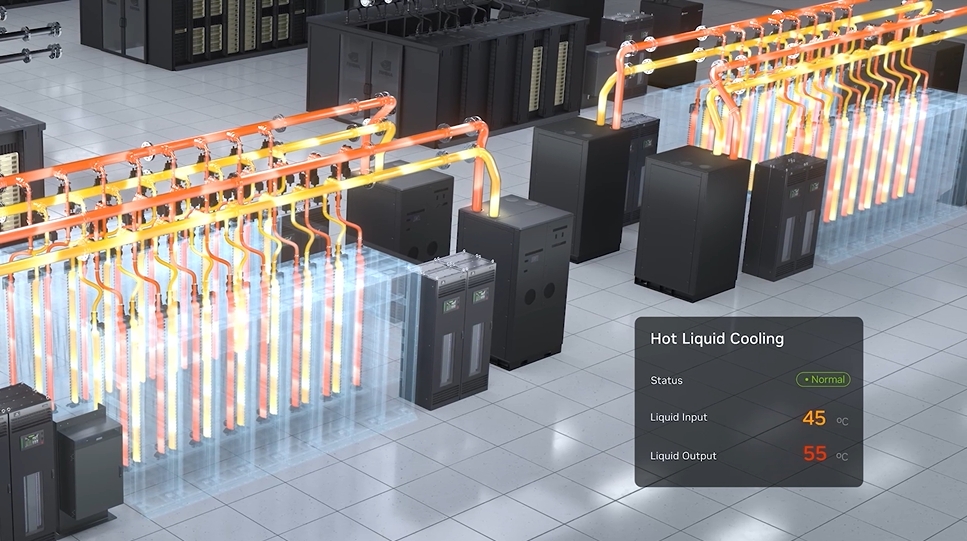
Additionally, full liquid cooling significantly reduces energy consumption in AI data centers, leading to substantial overall energy savings in hyperscale deployment scenarios. “Under NVIDIA’s DSX reference design for AI factories, we have eliminated a significant amount of power consumption and nearly all water usage,” stated Ali Heydari, Director of Data Center Cooling and Infrastructure at NVIDIA. Notably, the blog post extensively emphasizes the water usage advantages of full liquid cooling. In the Rubin architecture, coolant flows through cold plates directly attached to processor surfaces, absorbing heat at the source. Since the coolant operates at temperatures up to 45°C, facility-level circulation systems can dissipate heat without activating mechanical chillers or high-noise fans in many regions. According to China International Capital Corporation (CICC), the bottleneck of AI computing expansion is shifting from chip supply to power and thermal management supply, which has become the upgrade direction for AIDC construction. Analysts note that the 2026 AIDC investment theme is evolving: market focus is moving from standalone AI server shipments to the underlying infrastructure capabilities supporting large-scale AI clusters. With rising GPU/ASIC power consumption, increasing power density per rack, and continuous expansion of CSP capital expenditure, data center construction constraints now extend beyond chips and servers to power supply, distribution, cooling, and on-site energy generation. Investment opportunities in the AIDC industry chain should be upgraded from “server component volume growth” to “systematic restructuring of power infrastructure. ”